infiniti science

The obvious is well hidden. The Truth is not a theory. . . . . . . Simplex veri sigillum

Category: Truth

The symbol is never the actual

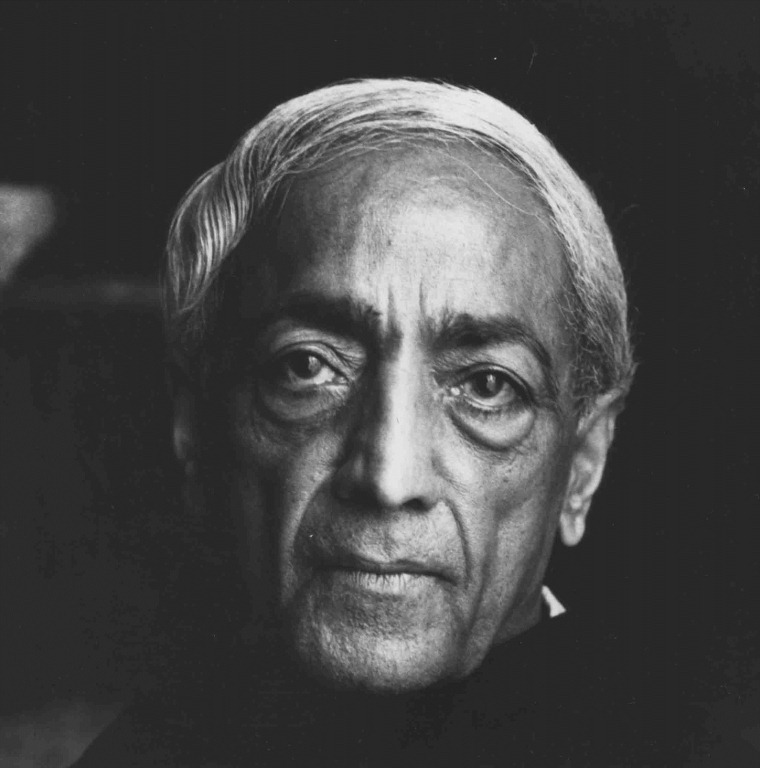
One of the fundamental questions consists in man’s relationship to reality. That reality has been expressed in different ways: in the East in one way and in the West in another. If we do not discover for ourselves what that relationship is, independently of the theoreticians and the theologians and the priests, we are incapable of discovering what relationship with reality is. That reality may be named as God, and the name is really of very little importance,because the name, the word, the symbol, is never the actual, and to be caught in symbols and words seems utterly foolish -and yet we are so caught, Christians in one way, Hindus, Muslims and others in other ways -and words and symbols have become extraordinarily significant. But the symbol, the word, is never the actual, the real thing. So in asking the question, as to what is the true relationship of man to reality, one must be free of the word with all its associations, with all its prejudices and conditions. If we do not find that relationship, then life has really very little meaning; then our confusion, our misery is bound to grow, and life will become more and more intolerable, superficial, meaningless. One must be extraordinarily serious to find out if there is such a reality, or if there is not, and what is man’s relationship to it.

J. Krishnamurti – Talks in Europe 1968,48,Social Responsibility

krishnamurti 01

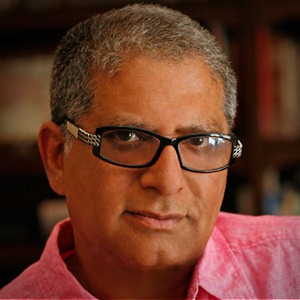
God and the Universe

God did not create the universe.
God became the Universe.

Dr. Deepak Chopra

Deepak_300_jpg

Freeing the mind

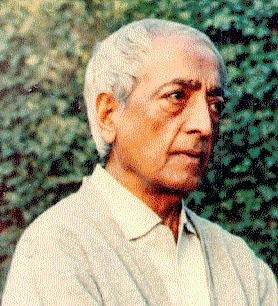
You work hard for your daily living, you spend years at the whole business of being bossed around in order to earn a livelihood, swallowing the insults, the discomforts, the indignity, the sycophancy. But to work so that the mind is free is much more arduous; it requires great insight, great comprehension, an extensive awareness in which the mind knows all its impediments, its blockages, its movements of self-deception, its fantasies, its illusions, its myths. Once the mind is free, it can begin to investigate, to search out, but for a mind to seek when it is not free has no meaning. Do you understand? The mind which would find truth, God, this extraordinary beauty and depth of life, the fullness of love, must first be free. It has no meaning for a mind that is shaped, conditioned, held within the boundaries of tradition, to say, ‘I am seeking truth, God.’ Such a mind is like a donkey tethered to a post: it cannot wander further than the length of its rope.

J. Krishnamurti – Collected Works, Vol. X”,164,Individual and Society

krishnamurti3

Limits of perception are not limits of possibility

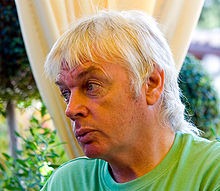
What is IS! Whether you think it is, or whether you think it’s not, it still is. We constantly confuse the limits of our own perception of what is possible with what is actually possible. And because we do that, we reject, by reflex action, things that are put forward, not because they can’t be supported but because they are outside the limit of our sense of possibility.

David Icke

david icke 01

Shake your chains to earth like dew

Stand ye calm and resolute,
Like a forest close and mute,
With folded arms and looks which are
Weapons of unvanquished war.

And if then the tyrants dare,
Let them ride among you there,
Slash, and stab, and maim and hew,
What they like, that let them do.

With folded arms and steady eyes,
And little fear, and less surprise
Look upon them as they slay
Till their rage has died away.

Then they will return with shame
To the place from which they came,
And the blood thus shed will speak
In hot blushes on their cheek.

Rise like Lions after slumber
In unvanquishable number,
Shake your chains to earth like dew
Which in sleep had fallen on you-
Ye are many — they are few

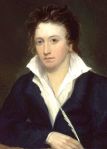
Percy Bysshe Shelley –  4 August 1792 – 8 July 1822
Percy_Bysshe_Shelley_by_Alfred_Clint_crop

Fear of Truth

It should be apparent that there is a fundamental truth in relation to Being.

Existence exists. Being is. Consciousness is conscious. These are the essential verities that underlie the field of ontology. All knowledge must eventually come back to these truths about being.

Yet we mostly do not ask ourselves what these truths mean with respect to our lives – how we should live, why we exist, who we are. There is a fear built into man that causes us to avoid such questions until the need to know is so great, the pain of existence is so extreme, that we demand answers lest we give up the struggle.

The very wise and erudite philosopher, Eponymous, once remarked:

“It is a strange fact about human beings that we are not more astonished and amazed by the fact of our own existence.”

Humans generally lack the ability to feel their own existence, their “beingness”. We are insensitive to the thrill of our own consciousness. It takes aeons of pain and suffering, it seems, to bring us from the thrall of the senses to the thrill of life itself. When it happens, I am told, the senses no longer play a significant part in our existence, and life itself takes over, invisibly and internally.

Mostly, we deny that there is any fundamental Truth with respect to existence – a source of Being and its manifestation in consciousness. We do not study experience – what it is, what it means, why it is as it is. We just feel the impacts of life rather than Life itself.

Eventually, I am also told, we will all come to the questions of life – who am I, why am I, where am I? I am also told that these questions do have answers. Surely, these are the questions that should occupy our time in this life.

Without asking these questions and dedicating our lives to the answers, we have no context or criteria for the mode in which we lead our lives. Then we are repeating the lives of others, as we have been told life is. But should not each of us find out for ourselves, first hand, what life is, who we are, and what is actually going on? Who are you to believe? Who found out, and why is their answer correct?

If we accept this, the story as told to us by another human that was here before us or claims a higher authority, we are the victims of sacerdotalism. Organised religions depend on our willingness to accept this. But why accept this? We must investigate our own stories. We must become interested in our own lives. We must become acutely aware of our existence – we are here, we are now, we are.

Time is a measure of opportunity. The opportunity is a life span. Time measures its passing. Surely, we can see that marching towards death with no purpose greater than this brief span is ludicrous. The very ridiculousness of such a proposition is the strongest argument for Truth. We must be able to see that the underlying fundamental of existence must be uncovered – else death is all we look forward to and daily life is just repetition and chaos.

Humans are given the ability to recognise the ludicrous and inane so that we might challenge our own assumptions. When challenged we will find that our assumptions collapse under the weight of their own improbability. Then we are free to explore and discover – to find out for ourselves. Then we begin to live our lives. We start to become conscious beings.

mc
The Ways

THE WAYS

To every man there openeth
A Way, and Ways, and a Way,
And the High Soul climbs the High Way,
And the Low Soul gropes the Low,
And in between, on the misty flats,
The rest drift to and fro.

But to every man there openeth
A High Way, and a Low,
And every man decideth
The Way his soul shall go.

John Oxenham
Selected Poems of John Oxenham

john oxenham